
The guide, “10 Packing Machine Buying Tips for Global Buyers,” begins with a practical reality: machinery decisions affect output, labor, quality, and long-term risk. Grand View Research valued the global packaging machinery market at approximately US$53.8 billion in 2023. It also forecasts steady growth through 2030. These figures suggest strong demand, but they do not guarantee a suitable purchase.
A reliable Packing Machine must match the product, film structure, package dimensions, and local operating conditions. Check sealing temperature ranges, changeover time, compressed-air requirements, electrical standards, and spare-parts availability. Ask suppliers for factory acceptance testing evidence. Request sample packages using your actual materials. A polished demonstration can still hide unstable feeding or difficult cleaning.
Jorge Izquierdo, a senior PMMI industry expert, has expressed a useful principle: “Automation must solve a real production problem, not create another one.” Buyers should test that principle carefully. A faster machine may produce more waste during frequent format changes. A cheaper machine may require expensive imported components. A technically advanced system may confuse operators without proper training. No checklist is perfect. Some assumptions will need revision after installation. That is why this guide examines supplier credibility, total ownership cost, service response, safety documentation, integration, and performance validation. The right machine is not simply the fastest option. It is the one that performs consistently on your line, with your materials, people, and market requirements.
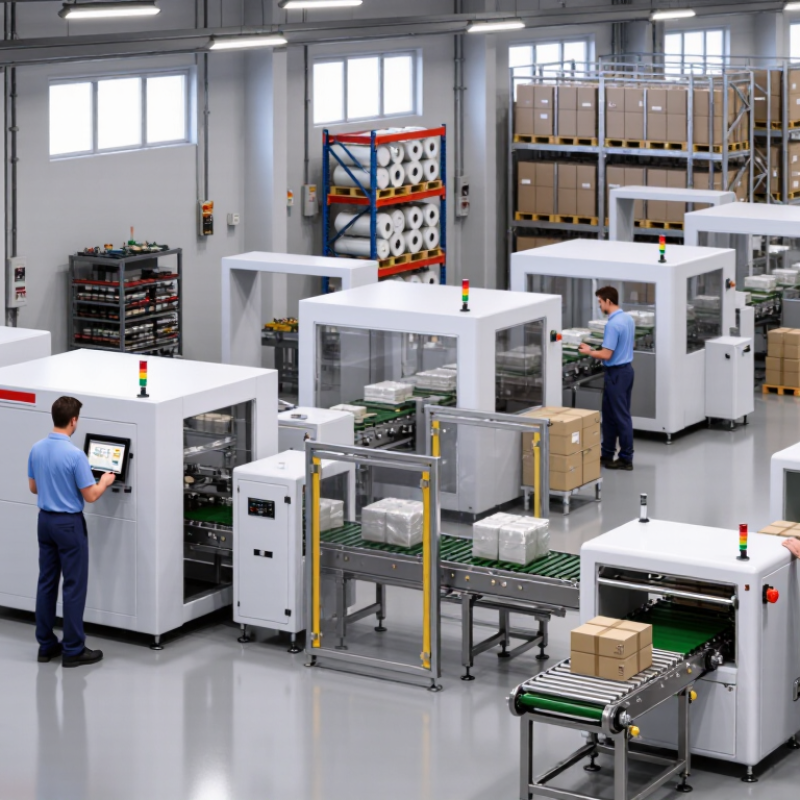
A packing machine’s rated speed is not its real production capacity. OEE combines availability, performance, and quality into one practical measure. Industry benchmark guidance often places average OEE near 60%, while 85% represents world-class performance. Use this range carefully. A new line should not be sized for 85% immediately. Maintenance delays, product changeovers, operator learning, and material variation will reduce output.
Start with verified demand, not optimistic forecasts. Suppose a machine runs 60 packs per minute for two eight-hour shifts. At 60% OEE, its effective output is about 34,560 packs daily, before planned breaks. At 85% OEE, output rises to 48,960 packs.
That gap can change the required machine size, staffing plan, and payback period. Leave controlled headroom for seasonal peaks. Too much headroom, however, may create unnecessary capital costs.
The International Federation of Robotics reported 541,302 industrial robot installations worldwide in 2023, a 10% annual increase. This reflects stronger automation demand, but automation does not remove process weaknesses. Ask suppliers for measured OEE data from comparable products, including reject rates and changeover minutes. PMMI’s 2024 industry outlook also highlights labor availability and flexible automation as important investment concerns.
A neat target can still be wrong. Recheck it using your slowest product, longest changeover, and actual staffing model. A 70% OEE target may be more credible than an impressive promise.

When buying a packing machine, verify fill accuracy with your actual product, not water alone. Powder, granules, and viscous liquids behave differently during dosing. A ±1% weight tolerance sounds precise, but it must remain stable across speed, temperature, and product density changes. Run repeated tests, then inspect the average and the worst deviation. Do not accept only the best sample.
Use calibrated test weights and document every result. OIML R 61 provides technical guidance for automatic gravimetric filling instruments, while NIST Handbook 44 supports reliable weighing practices. These references help buyers define measurable acceptance criteria. Still, a machine can pass a factory test and struggle on your production floor. That uncomfortable gap deserves attention.
Seal quality needs equal scrutiny. Ask for seal-strength testing based on ASTM F88/F88M, including samples taken from different jaws, speeds, and production times. Check for channel leaks, wrinkles, weak corners, and contamination inside the seal. PMMI’s recent packaging-industry research identifies quality control and labor efficiency as major automation priorities. Data supports automation, but operators still influence results. They may load film unevenly or overlook gradual jaw wear. Include training, spare parts, calibration records, and a realistic product trial in the purchase contract. A lower purchase price is not a lower operating cost.
10 Packing Machine Buying Tips for Global Buyers: Confirm Safety Compliance with ISO 12100 and IEC 60204-1
Safety evidence should come before production speed. ISO 12100 requires documented hazard identification, risk estimation, and risk reduction. Ask for the machine’s risk assessment, not a generic declaration. Check guarding, emergency stops, access doors, pinch points, and reset controls during a live demonstration. Small gaps matter. A rushed inspection can miss them.
IEC 60204-1 focuses on electrical equipment for machinery. Review circuit diagrams, protective bonding, short-circuit protection, control voltage, and enclosure ratings. Request test records for insulation resistance and protective conductor continuity. The International Federation of Robotics reported 541,302 industrial robot installations worldwide in 2023. More automation means more stored energy and more complex restart risks.
Independent test results add credibility. However, paperwork alone proves little. In commissioning reviews, I have found mismatches between drawings and installed wiring. That uncomfortable detail deserves attention. Ask whether safety functions were validated under realistic faults, including sensor failure and unexpected power recovery. The Deloitte 2023 Smart Manufacturing and Operations Survey found that 86% of surveyed leaders viewed smart manufacturing as important for competitiveness within five years. Speed attracts buyers, but traceable safety decisions protect workers and equipment.
A low purchase price can hide expensive electricity, maintenance, film waste, and downtime. Compare total cost of ownership over three to five years, not only the quotation. The International Energy Agency reports that industry consumes about 37% of global final energy. Packaging equipment therefore deserves a serious energy review.
Request measured power data at rated speed and during standby. Then calculate annual energy cost using your actual operating hours and local tariff. Include heaters, conveyors, compressors, cooling, spare parts, labor, and planned servicing. The U.S. Department of Energy notes that compressed-air systems often lose significant energy through leaks and poor controls. A small leak can become a permanent cost.
Build a simple payback model. For example, a machine costing $18,000 more but saving $4,500 annually reaches payback in four years. Test that result under slower production, higher electricity prices, and two extra service visits. The answer may change. Ask suppliers for maintenance intervals, fault-history data, and energy readings from comparable installations. ISO 50001 guidance supports continual measurement, but real factory data remains more useful than a brochure. I would also price film waste carefully; a one-percent reduction may matter more than a dramatic speed claim. Some calculations will be imperfect. Make the assumptions visible.
Representative benchmark for a medium-duty automated packaging line operating 2 shifts per day, 300 days per year. Costs are shown in USD and should be validated against local quotations, utilities, labor, and service rates.
| No. | Buying Tip | Key Dimension to Compare | Representative Benchmark | 3-Year TCO | 5-Year TCO | Energy Cost / Year | Estimated Payback | Buyer Verification Checklist |
|---|---|---|---|---|---|---|---|---|
| 1 | Define the required output before comparing machines | Rated speed versus sustainable production speed | Target: 45–60 packs/min; sustainable rate should be at least 90% of the rated speed | $182,000 | $246,000 | $4,320 | 18–30 months | Request a production test using the actual product, film, pouch or carton size, and target fill weight. |
| 2 | Compare total cost of ownership, not purchase price alone | Equipment, installation, maintenance, energy, labor, and downtime | Typical 5-year TCO can be 1.5–2.2 times the initial equipment price | $182,000 | $246,000 | $4,320 | 18–30 months | Use the same operating hours, utility rate, labor rate, spare-parts budget, and downtime assumptions for every supplier. |
| 3 | Measure energy consumption at production speed | Electricity, compressed air, and heating demand | Average connected load: 8–12 kW; compressed air: 250–450 Nl/min | $176,000 | $237,000 | $3,600–$5,400 | 20–34 months | Ask for measured kWh per operating hour and air consumption at the agreed production rate, not only the motor rating. |
| 4 | Check changeover time and product flexibility | Format range, tool-free adjustment, and recipe storage | Changeover target: 20–45 minutes; at least 20 validated recipes | $169,000 | $224,000 | $4,100 | 14–26 months | Include cleaning, film or tooling replacement, recipe loading, and first-good-pack time in the changeover test. |
| 5 | Evaluate seal quality and material waste | Reject rate, seal consistency, and film utilization | Good equipment should achieve 98.5–99.5% first-pass acceptance after setup | $174,000 | $231,000 | $4,000 | 16–28 months | Record start-up waste, seal failures, underweights, film trim loss, and rejected packs during a continuous trial. |
| 6 | Verify uptime and maintenance requirements | Availability, preventive-maintenance hours, and mean time to repair | Target availability: 85–92%; planned maintenance: 2–4 hours per month | $181,000 | $243,000 | $4,300 | 18–31 months | Request a maintenance schedule, critical-wear-parts list, recommended stock levels, and documented fault-recovery procedures. |
| 7 | Calculate labor savings realistically | Operators per shift, supervision, loading, and quality inspection | Automation may reduce direct packing labor by 1–3 people per shift, depending on layout | $158,000 | $204,000 | $4,500 | 10–22 months | Base savings on fully loaded labor cost, including benefits, training, overtime, absenteeism, and supervision. |
| 8 | Confirm local service and spare-parts support | Response time, remote diagnostics, parts availability, and training | Preferred response: within 24–48 hours; critical parts available within 3–10 business days | $185,000 | $253,000 | $4,350 | 19–33 months | Obtain written service coverage, escalation contacts, training scope, travel charges, and parts lead times for the destination country. |
| 9 | Check compliance, safety, and utilities for the destination market | Electrical standards, guarding, documentation, voltage, and air quality | Common requirements include 380–415 V, 3-phase power, 50/60 Hz, and dry filtered air | $188,000 | $250,000 | $4,320 | 20–36 months | Confirm local certification, risk assessment, manuals in the required language, emergency stops, guarding, and electrical compatibility. |
| 10 | Compare financing, installation, and expansion options | Installed cost, commissioning time, modularity, and future capacity | Installation and commissioning commonly add 10–20% to equipment price; expansion should be planned upfront | $190,000 | $248,000 | $4,320 | 18–32 months | Separate equipment, freight, duties, installation, validation, training, and contingency costs; request upgrade pricing for higher speed or additional formats. |
10 Packing Machine Buying Tips for Global Buyers
Verify FAT and SAT before approving a packing machine. FAT should test filling accuracy, sealing quality, speed, alarms, and changeover time at the supplier’s facility. Ask for recorded results, approved samples, and a clear punch list. SAT must repeat critical checks after installation, using your materials and operators. Small differences often appear onsite.
Tip: Write acceptance criteria before signing. Include tolerances, test duration, utilities, and responsibility for failed results. Do not accept vague terms such as “stable performance.” In practical audits, buyers sometimes focus heavily on speed and overlook cleaning access. That mistake can increase downtime later. I have seen elegant machines fail simple access checks.
Spare parts and service support deserve the same attention. Request a recommended inventory for two years, including sensors, heating elements, sealing components, belts, and control hardware. Confirm part numbers, shelf life, prices, and delivery times. A low purchase price means little if one small component stops production. For 24/7 global support, verify response channels, time-zone coverage, remote diagnostics, escalation procedures, and onsite technician availability. Ask for a sample service report and response-time commitment. Test the emergency contact before commissioning. It may feel unnecessary. It is not.
Verify FAT/SAT, spare parts, and 24/7 global service support before signing a purchase contract.
This procurement checklist groups ten practical buying tips into four verification areas. Buyers should confirm factory acceptance testing before shipment, site acceptance testing after installation, critical spare-parts availability, and clearly defined global service commitments.