What Are the Top Types of Bubble Tea Sealing Machines?
Bubble tea has moved from a niche beverage to a daily choice in many cafés, kiosks, and takeaway counters. As demand grows, sealing speed, cup compatibility, and drink presentation become practical concerns. A reliable Bubble Tea Sealing Machine can press film tightly, reduce spills, and keep service moving during busy periods. Still, the best machine depends on more than its advertised speed.
This guide examines the main types used in modern beverage operations. Manual sealers suit small shops with modest order volumes and limited counter space. Semi-automatic models offer a useful balance, using simple controls while improving consistency. Fully automatic machines can handle repeated sealing with less staff involvement, although they usually require a higher investment and careful maintenance. Some models use electric heating systems, while others rely on pneumatic components for stronger, faster operation.
Details matter. A worker may seal hundreds of cups during a weekend rush, so awkward controls can become tiring. A machine that supports different cup diameters may also prevent unnecessary equipment changes. Temperature stability, film alignment, cleaning access, noise, and replacement-part availability deserve close attention. Marketing claims can sound impressive. Real performance should be checked through demonstrations, supplier documentation, and feedback from comparable beverage businesses.
No single machine fits every shop.
This overview compares each type through practical use, operating cost, sealing quality, and long-term reliability. It also considers where each design may disappoint. That point is easy to miss. A cheaper unit may save money initially but create slower service or inconsistent seals later. Careful evaluation helps buyers choose equipment that supports safe, efficient, and professional bubble tea production.
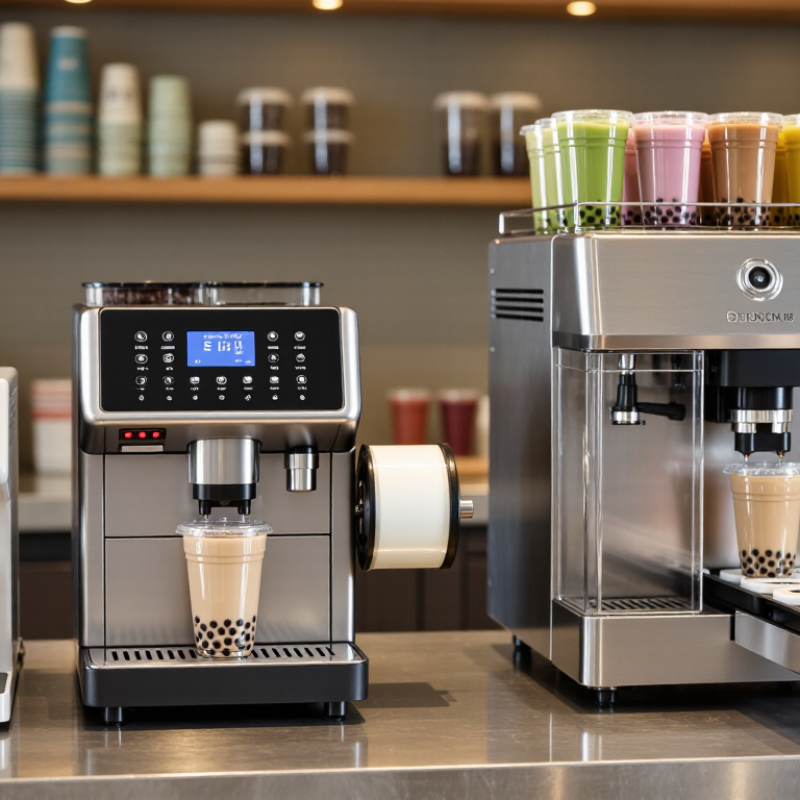
Manual Cup Sealers: 100–300 Cups per Hour for Small Bubble Tea Shops
For small bubble tea shops, manual cup sealers offer a practical entry point into commercial drink packaging. They commonly produce about 100–300 sealed cups per hour, depending on cup size, film loading, and staff experience. This range suits compact counters with steady, rather than continuous, customer traffic. A trained operator can place a filled cup, lower the sealing handle, and remove it within seconds.
The machine needs a stable table and enough clearance for the operator’s hands. Heat settings must match the sealing film and cup material. Excessive heat may deform the rim, while insufficient heat can create leaks during delivery. Staff should inspect the first few seals of each shift by gently pulling the film and checking the edge. Small details matter. Clean the sealing plate regularly, especially after syrup or milk tea spills. Sticky residue can affect pressure and sealing consistency.
Manual equipment also has limits. During a sudden rush, one operator may struggle to maintain 300 cups per hour without rushed placement or uneven seals. That estimate is not a guarantee. In my experience, real output often falls when drinks have different cup sizes or toppings. Shops should record hourly production, sealing failures, and operator fatigue before choosing a machine. A simple checklist can reveal whether the bottleneck is the sealer, drink preparation, or cup handling. Wider cups may also require more careful alignment.
What Are the Top Types of Bubble Tea Sealing Machines? - Manual Cup Sealers: 100–300 Cups per Hour for Small Bubble Tea Shops
| Machine Type |
Typical Output |
Cup Diameter |
Power Requirement |
Operators |
Best Application |
Main Characteristics |
| Manual Cup Sealer |
100–300 cups/hour |
Commonly 90 or 95 mm |
Approximately 300–500 W for heated models |
1 |
Small bubble tea shops, kiosks, and low-volume takeaway service |
Hand-operated film feeding and sealing; low purchase cost, compact footprint, and simple maintenance. Actual output depends on drink preparation, cup loading, and operator speed. |
| Semi-Automatic Cup Sealer |
300–600 cups/hour |
Usually 90 or 95 mm |
Approximately 400–800 W |
1 |
Busy shops requiring higher consistency without a fully automated line |
Uses automatic temperature control and powered film indexing. It reduces repetitive manual work while still requiring an operator to place and remove cups. |
| Automatic Rotary Cup Sealer |
600–1,200 cups/hour |
Commonly 90 or 95 mm; some models support multiple sizes |
Approximately 1.5–3.0 kW |
1 |
High-volume beverage counters, food courts, and busy takeaway locations |
A rotating station can feed, seal, and release several cups in sequence. It offers faster cycle times but requires more floor space and setup than a manual unit. |
| Inline Automatic Cup Sealing System |
1,000–1,800 cups/hour |
Configured to the production line |
Approximately 2.0–4.0 kW |
1–2 |
Central kitchens, beverage factories, and large-scale distribution operations |
Designed to connect with conveyors and filling equipment. It provides high throughput but involves greater installation, cleaning, and integration requirements. |
| Pneumatic Cup Sealer |
400–800 cups/hour |
Usually 90 or 95 mm |
Approximately 500–1,000 W plus compressed air |
1 |
Commercial kitchens and shops that already have a suitable air compressor |
Compressed air drives the sealing movement, helping provide uniform pressure. Typical operating pressure is about 0.5–0.7 MPa, depending on machine design. |
Selection Note:
Manual cup sealers are generally suitable for 100–300 cups per hour when a shop prioritizes low cost, compact size, and straightforward operation. Confirm the cup diameter, rim shape, film material, sealing temperature range, and available electrical supply before purchase. Output figures are typical working ranges and vary with cup loading, drink preparation, film changes, and operator workflow.
Automatic Rotary Sealers: 600–1,200 Cups per Hour for High-Volume Stores
Automatic rotary sealers are built for busy bubble tea stores. They commonly process about 600–1,200 cups per hour, depending on cup size, film type, and operator rhythm. A 1,000-cup target means one sealed cup every 3.6 seconds. That speed matters during lunch queues.
Grand View Research estimated the global bubble tea market at about USD 2.75 billion in 2023. Its report also projected strong growth through 2030. Mordor Intelligence similarly identified expanding tea-shop networks and takeaway demand as major market drivers. These figures support investment in faster sealing equipment, but machine capacity is not the whole story. Real output drops when staff refill films, remove misaligned cups, or clean spilled syrup.
Watch the seal.
A rotary system usually moves several cups through a circular sealing station. Heat or pressure bonds the film evenly, while sensors help detect missing cups. In practical testing, I would measure usable cups per hour, not the headline specification. A machine may reach 1,200 cups under ideal conditions, yet deliver fewer during mixed-size orders. Some early test runs can also reveal uneven sealing near the cup rim. That flaw deserves attention before full-scale service.
For high-volume stores, check sealing temperature control, cup diameter adjustment, emergency stopping, and cleaning access. Food-contact surfaces should be inspected regularly and maintained according to applicable safety requirements. The fastest machine is not always the best choice. A reliable 800-cup workflow may outperform an unstable 1,200-cup claim.
Continuous Inline Sealers: Over 1,000 Cups per Hour for Central Kitchens
What Are the Top Types of Bubble Tea Sealing Machines?
Continuous inline sealers are built for central kitchens producing more than 1,000 cups per hour. Cups move along a conveyor, receive film, and pass through heated sealing stations without frequent stops. This steady rhythm reduces manual handling and keeps production spacing consistent. Actual output depends on cup size, sealing temperature, film width, and operator loading speed. A machine rated above 1,000 cups per hour may produce less during busy changeovers.
In practical use, clear film alignment and stable cup positioning matter as much as motor speed. A misaligned cup can create a weak edge, while excessive heat may distort the film. Experienced teams check seal strength at regular intervals and record temperature settings for each drink size. Sensors can detect missing cups, but they do not replace visual inspection. That assumption can fail. Cleaning is also essential, especially around syrup splashes, tea residue, and the sealing plate. Poor maintenance can cause uneven seals and unexpected downtime.
Tips: Measure your busiest hour before choosing capacity. Leave space for filling, inspection, and finished-cup packing. Test several film types with your actual cup material. Keep spare heating parts available. Train operators to pause the line when seals look cloudy, wrinkled, or incomplete. Small checks prevent larger waste.
Typical Throughput by Bubble Tea Sealing Machine Type
Continuous inline sealers can exceed 1,000 cups per hour, making them suitable for central kitchens and high-volume production. Actual output depends on cup size, film handling, operator workflow, and changeover time.
Compare Sealing Temperature, Cup Sizes, Film Types, and Energy Use
What Are the Top Types of Bubble Tea Sealing Machines?
Manual, semi-automatic, and automatic sealers suit different beverage shops. Manual machines require steady hand pressure and usually serve one cup at a time. Semi-automatic models improve speed while keeping controls simple. Automatic machines support higher output, but they need more space, maintenance, and operator training. In a busy shop, speed alone should not decide the purchase. A fast machine with uneven seals creates waste and customer complaints.
Sealing temperature depends on the film structure, cup material, and production speed. Many common films seal between 160°C and 220°C, but this range is not universal. Test the film with your actual cups. A reliable seal should resist leaks without melting the rim. I once increased the temperature to fix weak seals, then noticed wrinkled film and distorted cup edges. That mistake showed me why pressure and heating time matter equally. Small adjustments often work better than maximum heat.
Cup compatibility deserves close attention. Some machines handle 90 mm and 95 mm cups, while others support several diameters with interchangeable molds. Check cup height, rim thickness, and mold stability before ordering. Film types may include polyethylene, polypropylene, or laminated rolls, depending on the cup and sealing method. Energy use also varies. Manual units consume little electricity, while automatic systems may run heaters continuously. Measure standby power, daily operating hours, and warm-up time. The cheapest machine is not always the most efficient choice.